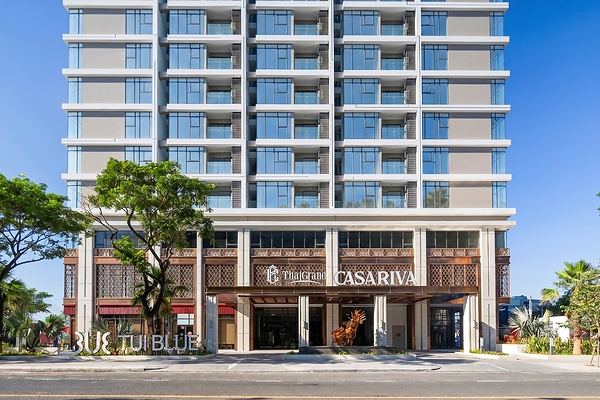
TUI BLUE Han River has opened in Da Nang, Vietnam, positioning itself as a new design-led flagship for the TUI BLUE brand in Asia. The 125-room hotel — developed by Thaigroup, designed by Dewan Architects + Engineers and launched on 8 August 2026 — pairs a riverside site with a suite of recent industry awards, signalling both local relevance and international ambition.
Design that negotiates global brand and local identity
The project exemplifies a familiar but difficult brief: reconcile an international operator’s brand language with a convincing sense of place. Dewan’s approach, as reported, treats architecture and interiors as a single continuous experience that frames views towards the Han River and the ocean. For operators and designers this is instructive: the value proposition of a branded hotel in a competitive leisure market increasingly depends on authentic localisation rather than uniformity. Here, the layered response — contemporary forms that reference regional craft and cultural motifs — demonstrates how a brand-standard toolkit can be adapted so a property reads as both recognisably TUI BLUE and distinctly Da Nang.
Operationally-minded aesthetics and asset performance
Beyond visual intent, the hotel’s brief emphasised operational alignment. The narrative accompanying the opening highlights optimisation of space and service flow, rooftop and wellness amenities, and multi-use public realms. Those decisions matter commercially: tighter room footprints, flexible F&B outlets and integrated wellness yield higher utilisation per square metre and simpler staff deployment. For owners this is a reminder that award-winning interiors must still answer questions of durability, maintenance and guest throughput — especially in resort-adjacent city locations where turnover and seasonal peaks are material to revenue management.
The project’s swift recognition at regional awards — Asia Architecture Design Awards (two categories) and a VMARK Gold — amplifies another point: in-market accolades can accelerate a new hotel’s visibility for both leisure guests and meetings/business travel planners. Awards lend third‑party credibility to marketing claims that a property is thoughtfully designed and operated to international standards. For Dewan, the plaudits also cement its positioning as a regional partner able to deliver branded hospitality at scale, which can shorten procurement and approval cycles for future developments.
Finally, the Han River hotel demonstrates how waterfront siting remains a potent design prompt. The building’s orientation and the choreography of indoor-outdoor sequences create experiential layers that extend the guest journey beyond the room. For designers this reinforces a practical maxim: capitalise on site-specific views and movement patterns early in the concept stage so that public and private programmes become mutually reinforcing rather than retrofitted.
Why this matters: For hospitality operators, developers and creatives, TUI BLUE Han River is a compact case study in balancing brand consistency, local storytelling and operational pragmatism. The combination of awards, a strong operator-designer alignment and a strategic riverside location underlines how considered design choices drive both guest perception and commercial performance — lessons applicable to any market where differentiation and efficiency must coexist.