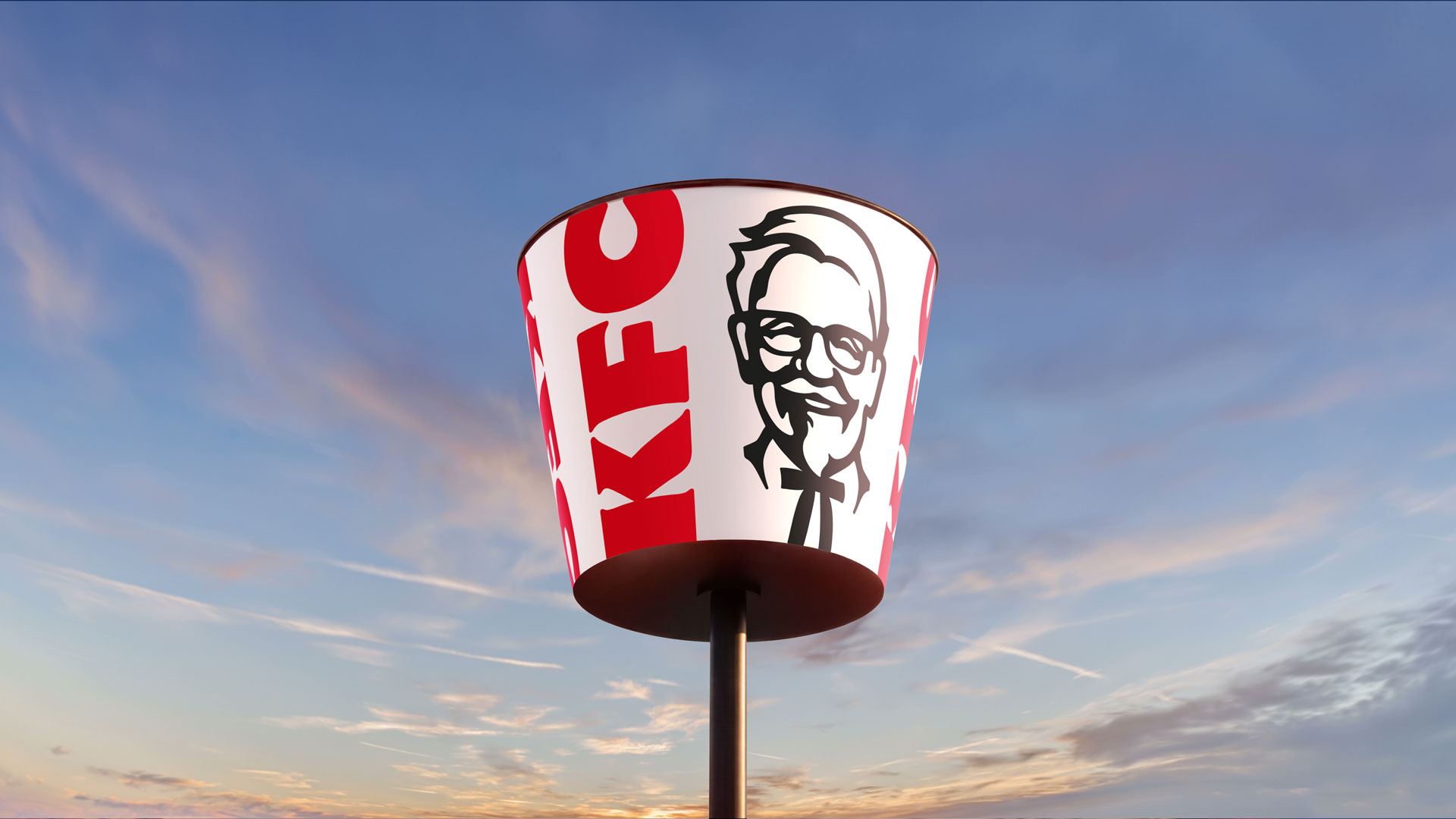
Creative Review reports that KFC has launched a global rebrand built around its most recognisable asset: the bucket. The refresh, created with Jones Knowles Ritchie (JKR) and dubbed the “Bucketverse” in press and industry coverage, treats the bucket not merely as packaging but as the organising device for identity, menus, restaurant design and digital content.
What the redesign actually does
Rather than strip the brand back to an abstract mark, the new system amplifies existing assets — the striped bucket, Colonel Sanders and the red-and-white palette — and adapts them into modular, motion-friendly components. JKR has remodelled the bucket as a framing device and storytelling portal, applying its silhouette across packaging, illustration, typography and advertising so that the product container becomes the centrepiece of visual language. The rollout has already been signalled in markets including the UK and Ireland, and forms part of a broader global programme that connects menu innovation (new sauces and a beverages push called Kwench) with refreshed interiors and experiential formats.
Design choices and cultural positioning
The strategy reads as an exercise in recognition over reinvention. KFC’s team and JKR have opted for evolutionary change — subtle logo and Colonel tweaks alongside bolder treatment of the bucket — which preserves legacy cues while opening up playful, collectible executions. The modular Bucketverse approach lends itself well to localised illustration and collaborations: agencies and studios from different markets have been invited to populate the bucket with regionally specific artwork, a move that scales global consistency with local personality. Early commentary from industry press and social channels suggests the refresh is motion-first and social-native, built to survive short-form formats and digital interactions as much as store signage.
Commercially, the refresh is timed to support Yum! Brands’ wider roadmap for KFC — from test restaurants (including dramatic two-storey or open-concept experiments) to promotional waves such as a recent “Free Bucket On Us” activation aimed at re-engaging lapsed guests. The brand shift therefore serves a dual purpose: contemporaryising how KFC tells stories, while creating a unified backbone for product launches and experience experiments across more than 34,000 restaurants worldwide.
Why this matters to hospitality operators and creatives
The KFC rebrand offers a short lesson in asset-led identity: when a brand owns a culturally embedded object, the safest routes to distinctiveness can be through amplification and systemic application rather than erasure. For operators, the Bucketverse shows how packaging-led thinking can inform menu architecture, in-store theatre and promotional mechanics without costly structural overhaul. For creatives, it underlines the commercial value of designing identities that flex across motion, social and local collaboration — a useful template for any hospitality brand that needs to be both instantly familiar and endlessly remixable.