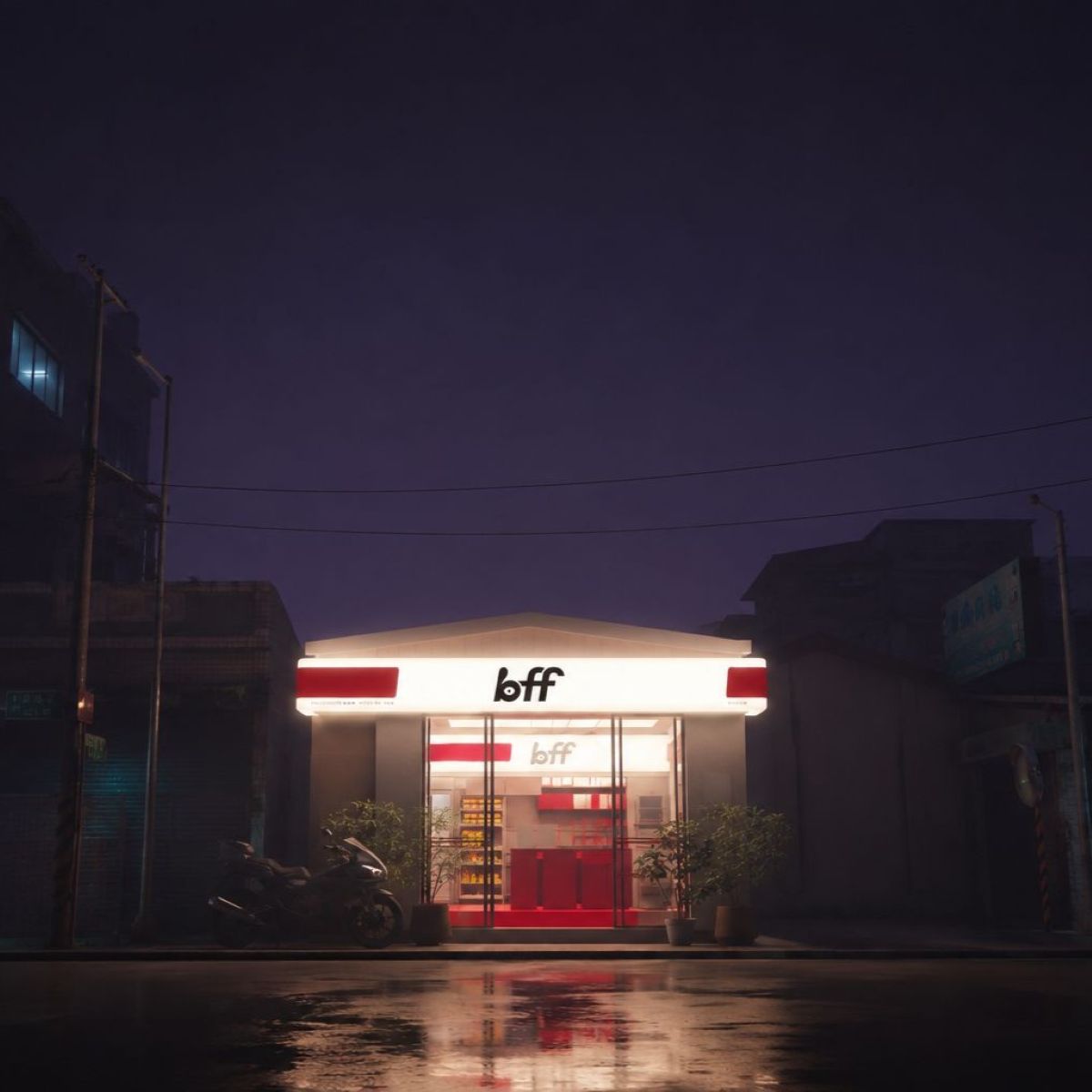
Bao’s new Bao Fast Foods (BFF) project reframes expansion as a design experiment: a convenience-store–inspired fast-food offshoot built in public, with its “Source Code” made available to collaborators. The move combines a clearly defined visual language with a participatory development model, inviting designers, operators and audiences to shape the concept before a permanent site opens in 2027.
BFF takes its cues less from Western quick‑service chains than from the dense, everyday infrastructure of East Asian convenience stores. That shift matters because it reframes “fast food” as a place-making opportunity rather than a purely transactional offer. The identity—developed with Hato—leans into the highly recognisable visual shorthand of Asian convenience-branding: strong primary colours, low‑resolution icons and a utility-first aesthetic. These choices intentionally trade slick restaurant gloss for something that reads as familiar, corporate and slightly uncanny, signalling accessibility and routine rather than exclusivity.
Open-source branding as a strategic experiment
The most striking structural gambit is Bao’s decision to publish a “Bao Source Code”: a public dossier of playbooks, product specs and design process material. This flips the traditional secrecy of roll‑outs on its head and treats brand development as a collaborative design system. For Bao this reduces the risk of a misaligned global rollout by crowdtesting elements early, and it creates a cultural marketing engine—contributors and observers become invested stakeholders in the brand’s evolution. Practically, it also creates a library of repeatable assets that can speed up future openings while allowing regional adaptation through communal feedback.
Design choices that support for-purpose utility
Visually, the identity’s balance of utility and nostalgia is a deliberate play. Functional icons and a restrained colour palette give signage clarity and repeatability—vital for fast-paced retail—while whimsical characters (a cat, a diner scene) add personality that prevents the system from feeling sterile. The product mix—Taiwanese fried chicken, noodle broths, nitro teas in frozen disposable cups—pairs with the convenience‑store framing to position BFF as a hybrid: quick, localised comfort food with habitual retail cues. A Taipei pop‑up test in June 2026 functions as a live prototyping ground before a full site in 2027, signalling a measured, data‑informed roll‑out rather than an immediate chain build‑out.
Operationally, open‑sourcing IP brings tradeoffs: it invites rapid iteration and community goodwill but risks imitation or dilution if governance of the code is weak. The model requires clear licensing, version control and curation to preserve brand integrity while encouraging contribution—issues that are more common in software than in hospitality, and that Bao will need to translate into practical brand governance.
Why this matters to hospitality operators and creatives
Bao’s experiment shows that branding can be treated as a living, communal design system rather than a finished artefact. For operators, the model offers a route to scale that foregrounds adaptability and local input; for creatives, it creates new modes of co‑creation and revenue around shared systems. If managed well, open‑source brand development could reduce the cost and cultural friction of expansion while generating richer, more locally resonant customer experiences—but it requires new skills in licensing, community management and iterative product testing that hospitality teams should start learning now.