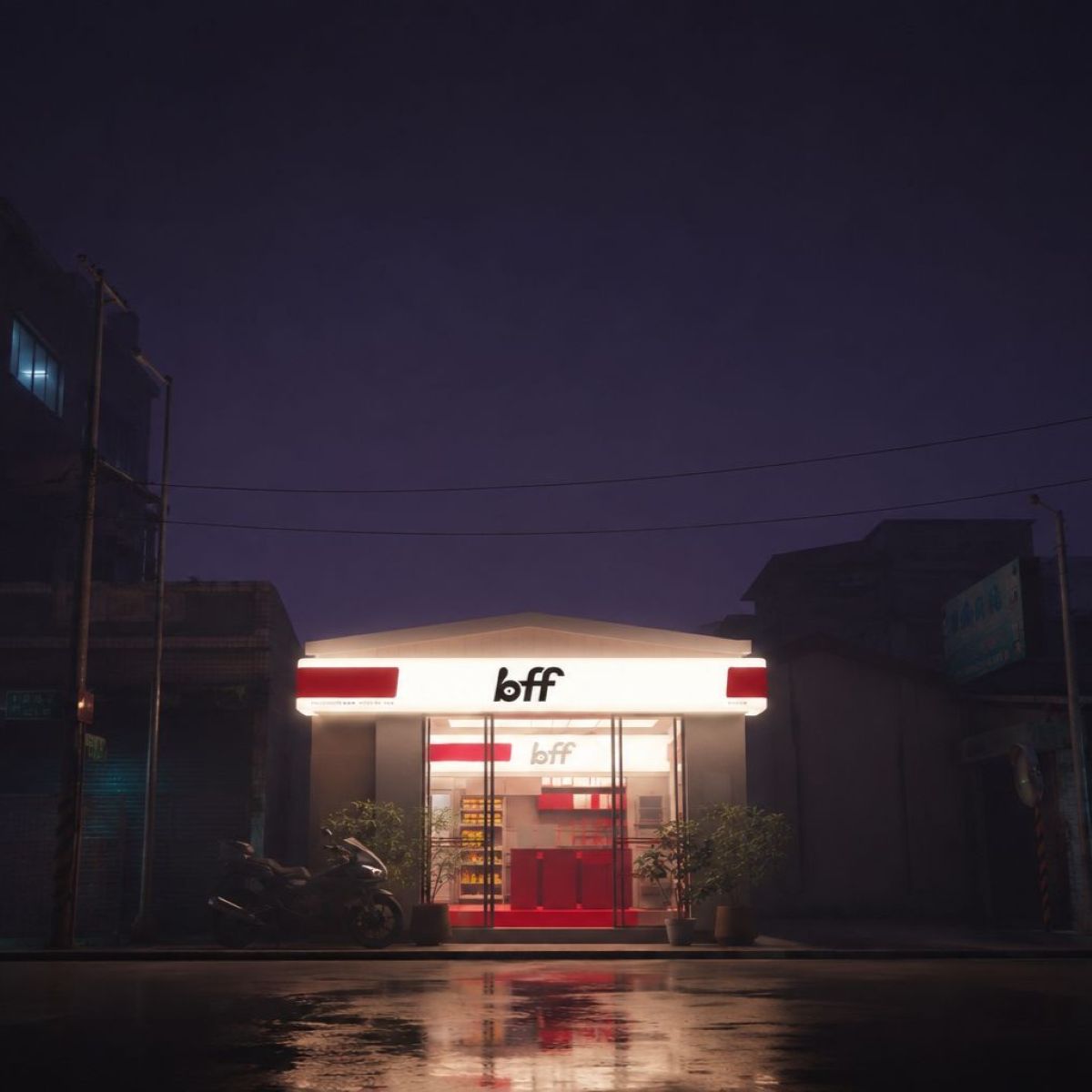
Bao Fast Foods (BFF), the latest concept from London’s Bao group, reframes fast food as an open‑source design system rather than a fixed brand package. The project, developed with designers and presented in a Taipei pop‑up, treats logos, signage and menu architecture as modular rules and shared assets — an attempt to make a restaurant identity adaptable, localisable and collaborative.
From logo to toolkit: what open‑source branding looks like
Rather than a single static mark, the BFF identity is presented as a set of interchangeable elements: typographic modules, palette rules, packaging patterns and behavioural constraints for how assets are combined. This approach is clearly indebted to software thinking — versioning, forks and contributions — and repositions a hospitality brand as a living system. For BAO, whose practice has long mixed food, art and graphic playfulness, the method allows rapid iteration of ephemeral formats (pop‑ups, collaborations, convenience‑store aesthetic concessions) while retaining an idiosyncratic throughline. The result reads less like a corporate identity and more like a toolbox for local operators, pop‑culture partners and collaborators to remix without losing recognisability.
Design implications for hospitality and experience
Operationally, an open‑source identity lowers friction when translating a concept across formats. A compact rulebook for menus, counter decals and merchandise means a Taipei pop‑up can look coherent with a London kiosk without prescriptive, costly rollouts. Creatively, it invites participation: local designers, suppliers or neighbouring brands can adapt modules to reflect context, producing a richer patchwork of outputs that still feel part of the same family. That said, decentralised branding risks dilution if governance is weak; successful open systems need clear constraints and active curation to ensure quality and protect equity in the brand’s signal.
The cuisine and service ideas dovetail with the visual strategy. BFF trims menus to portable gestures (reworked fried chicken, on‑the‑go bowls, convenience‑style snacks) that suit fast operations and mobility. Pairing tightly defined food formats with a modular graphic system makes iteration cheaper — new items can be promoted via pre‑existing templates and distributed across channels and locales quickly. It’s a practical answer to the current hospitality imperative: stay nimble, collaborate, and make every physical touchpoint an opportunity for storytelling.
Why this matters to operators and creatives
For operators, Bao’s experiment shows how deliberate design infrastructure can reduce rollout costs and accelerate concept testing across cities. For creatives, it signals a shift from one‑off identity briefs to building reusable systems that foreground rules, not reverent logos. Both groups should take note: open‑source brand thinking can amplify local relevance and drive faster product‑market fit — provided governance and craft are not sacrificed in the name of openness. In short, BFF is a reminder that scale in hospitality no longer needs to mean standardisation; it can mean a well‑engineered language that invites contribution.