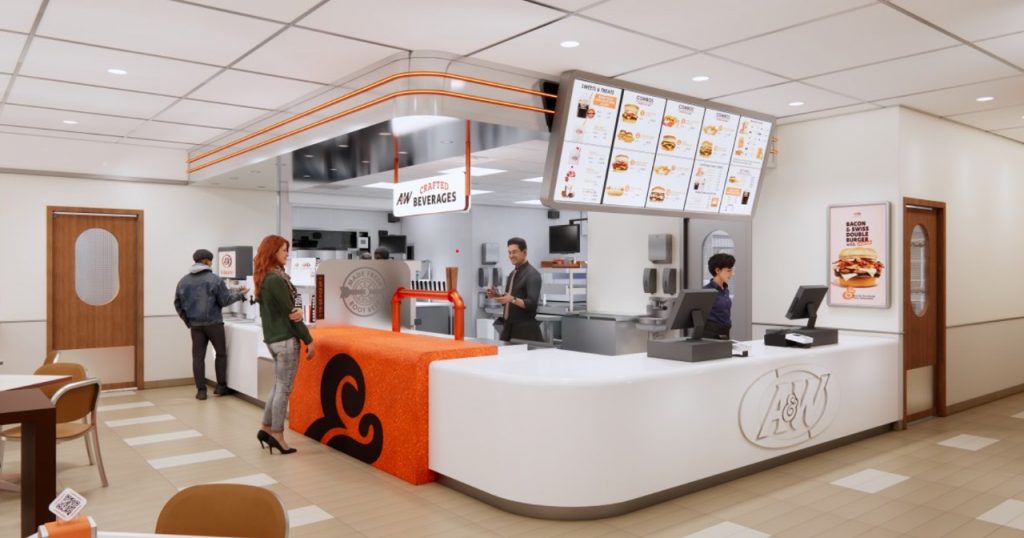
A recent Modern Restaurant Management brief outlines how A&W Restaurants is marrying a refreshed, heritage-led design with flexible, right-sized prototypes and an expanded beverage programme. The chain’s strategy leans on a “Hometown Hospitality” ethos while using smaller footprints and technology to reach non-traditional and core markets alike.
Right-sized footprints and strategic growth
A&W’s new prototype, which spans 2,200 to 2,800 square feet and seats roughly 40 to 70 guests, signals a deliberate pivot away from a one-size-fits-all roll‑out. By designing a shell that can be adapted for streetside restaurants as well as compact, non-traditional sites such as airports, college campuses and military bases, the brand gains the operational flexibility franchisees covet. That flexibility reduces the entry cost and real‑estate constraints that often block growth, allowing A&W to pursue measured expansion rather than rapid unit accumulation. The stated focus on strengthening presence across the brand’s Midwest footprint—Indiana, Illinois, Iowa, Michigan, Minnesota, Ohio and Wisconsin—while selectively entering new markets suggests an emphasis on market density and partner quality over geographic breadth.
Design that honours heritage while enabling modern service
Visually and behaviourally, the redesign is conservative in spirit but modern in execution. It nods to the brand’s diner and roadside-stand origins—keeping handcrafted root beer and the “First Pour” ritual front of mind—while reconfiguring back-of-house and guest flows to support contemporary service modes. The prototype deliberately accommodates multiple ordering pathways (kiosks, front counter, tableside, drive-thru, third‑party delivery and catering), which positions the brand to satisfy different guest preferences without diluting the in-person hospitality that A&W calls “Hometown Hospitality.” That balancing act—preserving a human-centred service promise while adopting labour-saving and convenience-enhancing technology—will determine whether the refreshed look translates to stronger guest frequency and higher per‑capita check averages.
Operationally, the model eases the training and onboarding of staff—referred to by the brand as “Awesome Ambassadors”—by standardising a hospitality narrative that spans small and large sites. For franchisees, a modular prototype that supports consistent branding and service, yet is adaptable to site constraints, can simplify site selection, buildout budgeting and performance forecasting.
Why this matters to operators and creatives: For operators, A&W’s approach is a reminder that growth can be achieved by right‑sizing assets and aligning prototype capabilities to real guest behaviours rather than chasing uniformity. For designers and brand teams, it demonstrates how heritage cues can be reinterpreted to enable omnichannel service—maintaining emotional brand touchpoints (the handcrafted root beer ritual) while solving for modern operational demands. The case underscores a practical lesson: contemporary hospitality design must reconcile authenticity with adaptability, so brands can be both recognisable and reachable in a wider range of physical and commercial contexts.