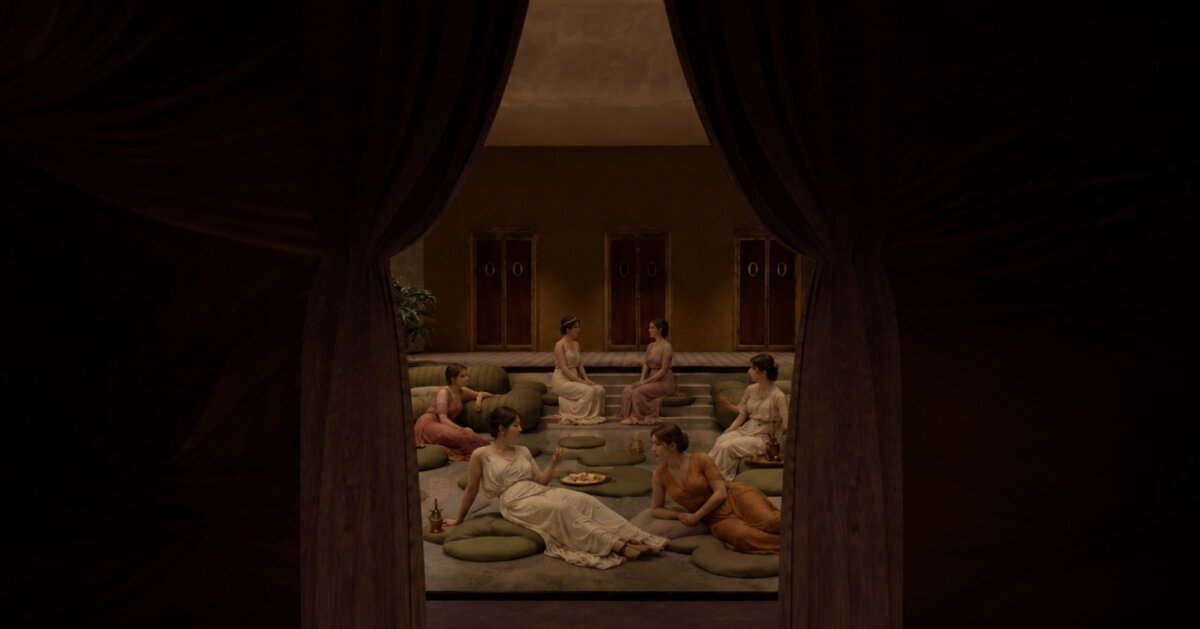
Hazel Yu’s Thistle & Bloom is a conceptual boutique hotel that retells Thumbelina as a series of interior encounters. Rather than literal pastiche, the proposal uses the fairytale’s key episodes as a framework for circulation, enclosure and atmosphere — a sunken, lily-pad-like lobby, birdcage-inspired seating and an arched cocktail bar — with a consistent palette of deep greens and purples binding the sequence together.
Layered narrative as spatial organiser
Thistle & Bloom treats narrative not as decoration but as an ordering principle for movement. Yu translates moments from Thumbelina into architectural devices: winding routes that slow and surprise, concealed lounges that create partial visibility, and a central conversation pit modelled on the tale’s swamp scene. The value of this approach is its ability to choreograph guest journeys — arrival becomes discovery, circulation becomes dramaturgy — which in turn repositions the hotel from a purely transactional place to a staged, memorable environment.
Materiality, light and the illusion of scale
Where many themed projects risk pastiche, the concept relies on restrained material strategy and lighting to achieve immersion. Oversized botanical gestures, elongated planters and layered screens establish a sense of being “within” a landscape without resorting to props. Cinematic lighting and a tight chromatic range of green and purple allow the interiors to shift mood between intimacy and theatricality. The scheme’s use of partial enclosures (birdcage structures, sunken pits) tests how sightlines and acoustic separation can be calibrated to produce both privacy and social animation in a compact footprint.
Thistle & Bloom has also been recognised within the design awards circuit as an example of immersive interior thinking, indicating growing professional interest in hospitality that borrows dramaturgical tools from theatre and exhibition design. The project’s inclusion in competitions and online criticism underscores how narrative-driven concepts can travel quickly from speculative exercise to industry reference point when they articulate both spatial logic and guest experience clearly.
For operators and creatives, the project offers practical cues: use narrative to shape movement rather than simply to ornament spaces; invest in material and lighting decisions that sustain emotional shifts across a guest’s stay; and design partial reveals that reward exploration. The balance Yu strikes between suggestion and literalism is the relevant lesson — immersive hotels succeed when their story becomes a mechanism for wayfinding, atmosphere and repeatable hospitality rituals, rather than a one-off visual stunt.